















Does Breastfeeding Cause Cavities? Three October Studies on Screens, Night Feeds and the Dentist

It is late, the house is finally quiet, and the toddler on your lap is drifting off at the breast or with a bottle, a cartoon still glowing on the tablet beside you. Nobody brushes teeth at that moment. Nobody should feel guilty about that moment either. But in October 2026 three studies looked hard at exactly this hour of a child's day, and their numbers deserve a calm reading by every parent of a child under three.
Here is what each study found, what it cannot prove, and the one habit all three point to.
Does breastfeeding cause cavities? The Japanese numbers
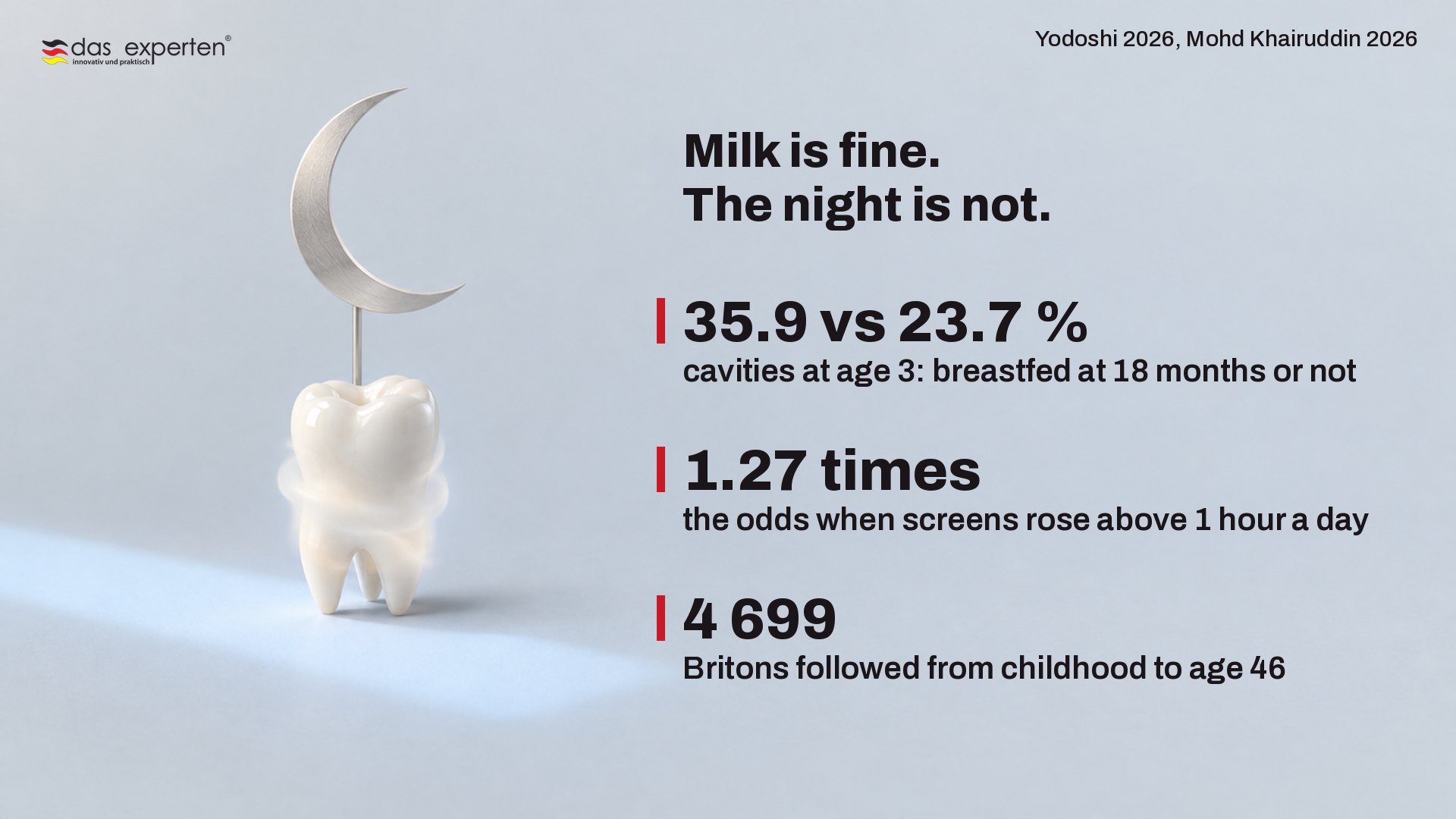
On 13 October the International Journal of Paediatric Dentistry published a study of 69 165 children from routine check ups in Japan between 2014 and 2019. At 18 months, 12 788 of them, 18.5 %, were still breastfeeding. At age 3, cavities were found in 35.9 % of those children against 23.7 % of the rest, and severe cavities in 19.2 % against 10.5 %.
The author then adjusted for sweet juice, screen time, parents helping with brushing, single parent households and parental work. The link held: odds of any cavities 1.89 times higher, of severe cavities 2.14 times. It held even after counting the cavities a child already had at 18 months (odds 1.74), so it is not simply that children with sore teeth were nursed more.
This is not a new alarm. In 2017 a Brazilian birth cohort of 1 303 children found severe cavities at age 5 2.4 times more often after breastfeeding for 24 months or longer than after breastfeeding up to 12 months; between 13 and 23 months it found no effect.
Milk is not the villain. The hour is
Read the advice the Japanese author draws from his own data: do not make feeding the way a child falls asleep, and clean the mouth after a feed. The problem the numbers describe is timing. During sleep the flow of saliva, the mouth's own rinse and buffer, becomes negligible, as a 2008 review in the Journal of the American Dental Association put it, which is why the most important brushing of the day is the one just before bed. Milk that stays on new teeth all night meets no saliva to wash it away.
So the guidance has not turned against breastfeeding. The World Health Organization still advises breast milk alone for the first 6 months and breastfeeding alongside other foods up to 2 years or beyond. The American Academy of Pediatric Dentistry, in its 2025 policy, asks for something narrower: avoid on demand and night feeding, by bottle or breast, after 12 months.
Screens at age 2: 1.27 times the odds
On 7 October the same author published a second study, in Pediatrics and Neonatology, from check ups of 71 438 children in Okinawa. Children whose screen time climbed above 1 hour a day between 18 months and age 3 had 1.27 times the odds of cavities at age 3 compared with children who stayed low, and 1.55 times the odds of severe cavities. Children with high screen time at both ages had odds 1.11 times higher. Screen time did not predict obesity once earlier weight was counted.
A screen does not dissolve enamel. What the authors suggest, and it is their inference, not a measurement, is what travels with the screen: grazing snacks and drinks while watching, and brushing that is rushed or skipped. Their advice is to keep meals and toothbrushing free of screens. It matches the American Academy of Pediatrics, which since 2016 has asked for no more than 1 hour a day of screens for children aged 2 to 5.
Childhood dental visits: the habit, not the chair
The third study, published on 13 October by researchers at King's College London, followed Britons born in 1970. In 4 699 of them, dental visits recorded at ages 5, 10 and 16 were compared with oral health at age 46, when 23 % rated their mouths poor. The direct effect of childhood visits was very weak (odds 1.03). Most of the benefit ran through a habit: regular visits in childhood went with better brushing later, and better brushing with better oral health. Poor oral health was more common among people who brushed less than twice a day and among smokers.
The dental chair, in other words, mattered mostly as a school for the toothbrush. The same study found that parents' social class shaped both the visits and the adult outcome, a reminder that habits are built at home before they are built in a clinic.
What all three studies point to
All three are observational: they show strong, repeated links, not proof of cause. Two of them come from one author and one Japanese check up system. But together they draw the same picture, and it is practical. The risk sits in the hours when a small mouth has milk, juice or snacks on its teeth and nobody brushes afterwards.
Brush with a smear of fluoride toothpaste from the first tooth, twice a day, the last time after the final feed. From the first birthday, try to make sleep happen without the breast or bottle in the mouth. Keep the tablet away from meals and the bathroom. Book the first dental visit within 6 months of the first tooth and no later than the first birthday, as the 2025 dental guidance asks, and go back regularly so the habit has a teacher.
Breastfeeding does not need to stop to protect a toddler's teeth. What needs to change is the last minute of the day: milk, then a toothbrush, then sleep.