















Does Saliva Heal Wounds? In AD 77 Pliny Prescribed Spit Before Breakfast, and Half of It Was Right

The lamp is lit long before dawn. A Roman official sits at his books with a reader beside him and a secretary taking down every word he says. Pliny the Elder works this way every day, his nephew wrote: books before sunrise, the emperor Vespasian before sunrise, and nothing to eat yet. Around AD 77 he is dictating the twenty eighth book of his Natural History, the remedies a human body can supply for itself. He reaches the mouth.
“It is the fasting spittle of a human being,” he dictates, that guards against the poison of serpents. A boil, when it first appears, is marked three times with fasting spittle. Lichens and scaly spots on the skin fade under it if it is applied again and again. Sore, inflamed eyes are anointed with it every morning. Fasting spittle means the saliva of a mouth that has not yet eaten: exactly the mouth of a man who works through the night and takes his first meal late.
Then, in the same breath, Pliny keeps going. Romans spit to ward off epilepsy, he says, and the evil eye, and the bad omen of meeting a man lame in the right leg. They spit into the right shoe before putting it on. A man who regrets striking someone should spit into the palm of the hand that struck, and the victim’s resentment will ease at once.
Does saliva heal wounds? Rome wrote yes, and then buried it
Read the chapter today and the problem is obvious. Two observations a grandmother could repeat, a boil and a sore eye, sit in one list with a shoe, an omen and a punch. Nothing in the text separates them. Pliny was not a fool; he was a collector, and the collection had no filter.
Nearly three thousand kilometres east, in Babylonia, the same knowledge survived in a stranger container: a law. The Babylonian Talmud, compiled there over the following centuries, rules that on the Sabbath a Jew may not even place bland, fasting saliva on the eye, because that is a medical treatment, and healing is work. Nobody bans what nobody uses. The best evidence that saliva was ordinary medicine in ancient Mesopotamia is a rule forbidding it one day a week.
That is the silence at the centre of this story. Rome kept the remedy inside a list of charms; Babylon kept it inside a prohibition. Neither had a word for why it might work, so for the next eighteen centuries educated medicine filed spittle where it found it, under superstition. A theory had no room for it, and a remedy without a theory became folklore: the cat licking its paw, the child sucking a cut finger.
Lysozyme: the enzyme in a cold
The word for why came from a runny nose. On 21 November 1921, in a laboratory at St Mary’s Hospital in London, Alexander Fleming had a cold. Out of curiosity he put a drop of his own nasal mucus on a culture plate. Bacteria grew across the plate, except in a ring around the drop. Something in the mucus was dissolving them. Fleming tested his tears, then saliva, and found the same thing. In his 1922 paper to the Royal Society he named it lysozyme: an enzyme that cuts the wall of a bacterial cell until the cell bursts.
Pliny’s fasting spittle finally had a molecule. Lysozyme is the single agent that joins the Roman list to the modern laboratory, and it turned out to be everywhere the body meets the outside world: tears, saliva, mucus, breast milk. In 1965 David Phillips used it for a first: lysozyme from egg white became the first enzyme whose three dimensional structure was solved by X ray crystallography. Historians now call Fleming’s paper the birth of innate immunity, the body’s own chemical defence that works before any antibody is made.
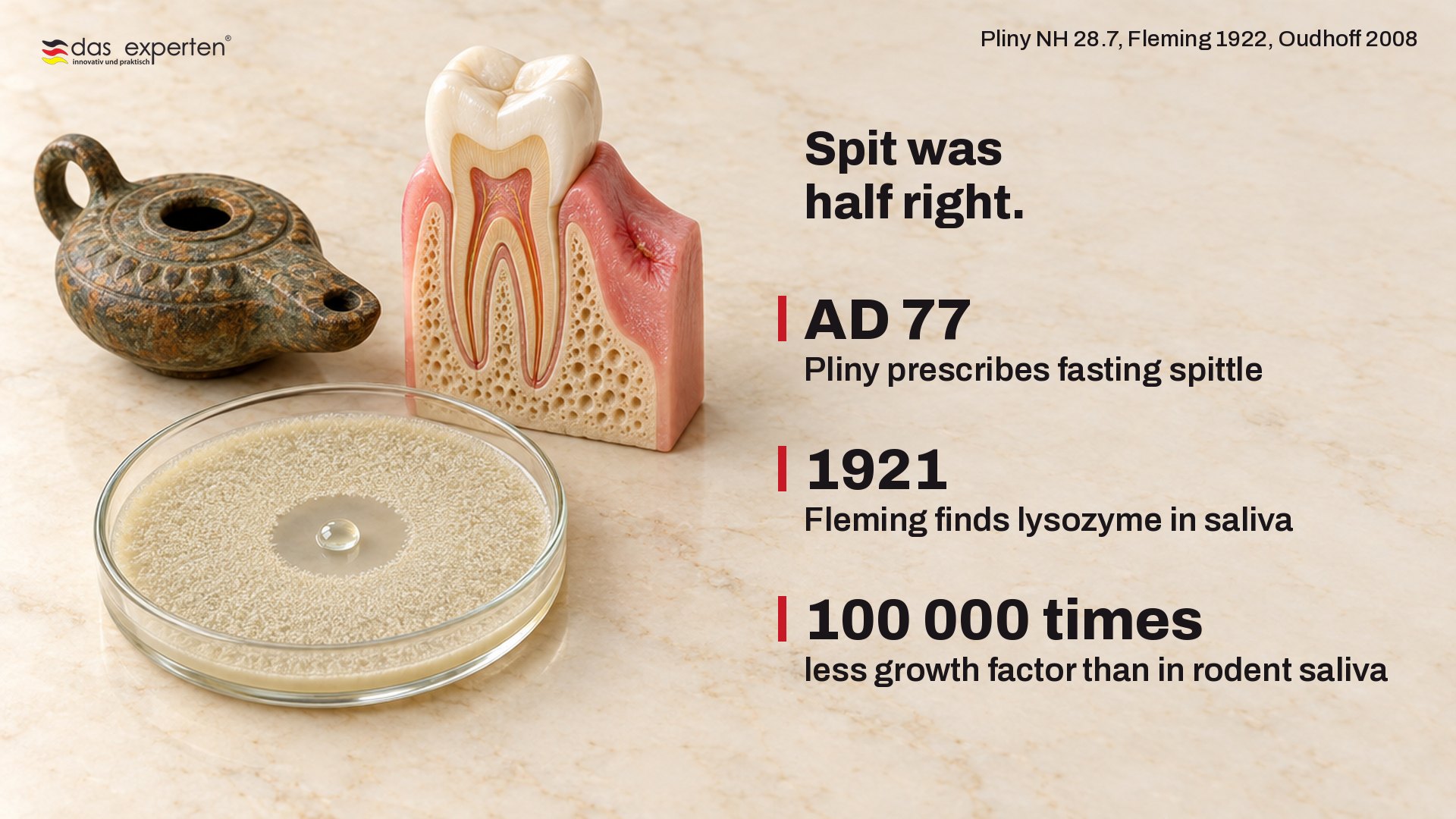
There was a catch, and Fleming saw it himself: lysozyme did little against the bacteria that kill people. Seven years later he noticed a mould killing staphylococci on another forgotten plate, and penicillin pushed his first discovery off the stage. Saliva went back to being something polite people do not discuss.
Why mouth wounds heal so fast
The second half of the answer took until this century. Every dentist knows that a bitten cheek or a cut on the gum closes in days, while the same cut on a knuckle takes much longer. In 2008 a team at the Academic Centre for Dentistry Amsterdam separated human saliva into fractions and tested which ones made a layer of cells close a scratch. The winners were not growth factors. They were histatins 1 and 2, small salivary proteins that until then were known only as weapons against fungi. Histatins pushed the cells to migrate across the gap (Oudhoff et al. 2008). In 2017 a Chilean team showed that histatin 1 also helps new blood vessels form (Torres et al. 2017).
The same Amsterdam paper contains a number worth remembering. Rodent saliva is rich in growth factors such as EGF and NGF; in human saliva their concentrations are roughly 100 000 times lower. A mouse licking its wound is doing something a person cannot copy. And in 2018 researchers at the US National Institutes of Health compared paired biopsies of mouth and skin wounds in the same volunteers: the lining of the mouth keeps its repair programme switched on even before any injury, ready to close (Iglesias Bartolome et al. 2018).
Should you lick a wound? The half Pliny got wrong
So saliva does help wounds heal, inside the mouth, where it bathes the injury all day and the tissue is built to answer it. Outside the mouth the arithmetic changes. Saliva is not sterile: the mouth holds more than 600 common species of bacteria (Dewhirst et al. 2010), and a cut on the skin has no saliva flowing over it to keep the balance. Lysozyme in a lick is a trace; the bacteria arrive in force. Pliny’s boil and sore eye were exactly the cases where a mouth should stay away. A cut on a finger wants clean running water and a dressing, not your tongue, and certainly not your dog’s.
Now the part that is about you. Tomorrow morning, before breakfast, you will have the mouth Pliny wrote about: fasting, full of lysozyme and histatins, quietly repairing whatever you bit or scraped yesterday. Then you will brush it. You can scrub that mouth with detergent and grit, or you can clean it with something that works in its own language. This is not a question of trend. It is a question of which century is standing on your sink.
Our TERMO 39° toothpaste lists lysozyme among its ingredients, beside the enzymes papain and dextranase, with sodium sarcosinate instead of sodium lauryl sulfate and no fluoride. Nobody has tested it on a Roman boil, and the studies above were done on saliva, cells and biopsies, not on our tube. What it keeps is the molecule Fleming found in his own runny nose, the one already working in your mouth.
Pliny was right that the fasting mouth heals itself. He was wrong to take it anywhere else: saliva is medicine for the mouth it lives in.