















How Much Toothpaste Should You Use? A Pea Weighs 0.25 g, and Parents Squeeze Double
Watch any toothpaste advert and you will see the same shot: a glossy wave of paste running the full length of the brush and curling over the end. Now read the guidance. For a child aged 3 to 6 it asks for an amount the size of a pea, and somebody has weighed that pea: 0.25 g. Between the advert and the pea sits most of the toothpaste squeezed in real bathrooms, possibly in yours.
Here is that gap in numbers, from studies that weighed what people actually put on the brush, and what the numbers mean at every age.
How much toothpaste should a child use?
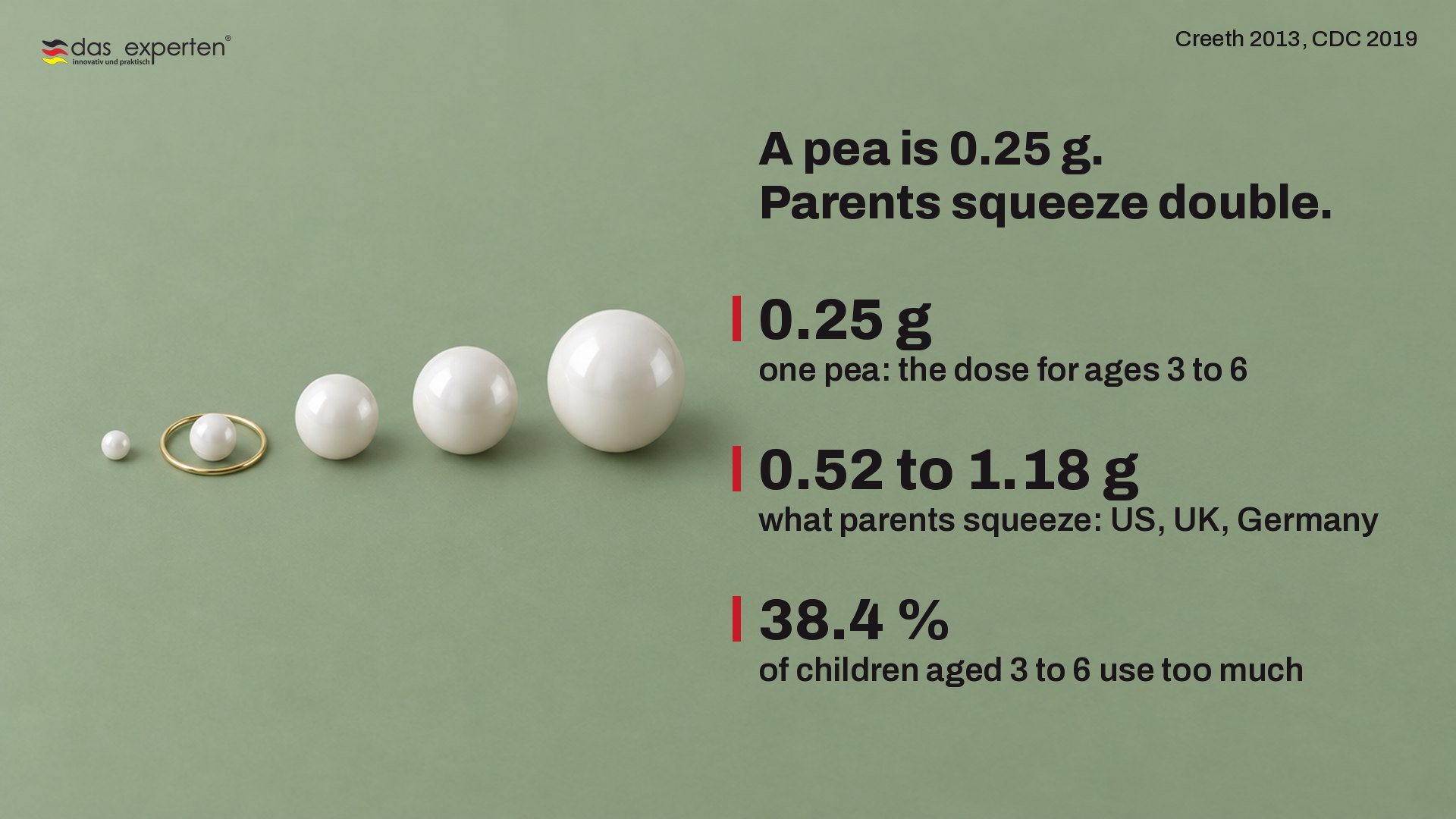
The rules are short. In the United States the CDC advises a smear the size of a rice grain for children under 3, and no more than a pea sized amount, 0.25 g, from 3 to 6. England's toolkit for dental teams, updated in September 2025, says the same in its own words: from the first tooth a smear of paste with at least 1 000 ppm fluoride, a pea sized amount from 3 to 6, twice a day, the last time before bed.
A pea of a 1 000 ppm paste holds 0.25 mg of fluoride. That small number is the whole dose the rule is built around.
What parents actually squeeze
In 2013 a research team weighed it. They asked 600 parents of children aged 3 to 6, 200 each in Germany, the United States and the United Kingdom, to put toothpaste on a child's brush the way they normally do. The average was 0.52 g in the United States, 0.57 g in the United Kingdom and 1.18 g in Germany, where every single parent dispensed more than the recommended amount. Then the parents were asked for a pea sized amount. The averages fell, to 0.41, 0.50 and 0.60 g, and stayed above 0.25 g in all three countries. In the United States, parents who used an electric toothbrush dispensed about 0.1 g more. The study came from a toothpaste manufacturer's research team; a weighing is still a weighing.
Put plainly: a pea in an adult's mind is closer to two peas.
38 in 100 young children use too much
The CDC looked at the same habit from the other side, through a national survey of 5 157 children and teenagers aged 3 to 15 between 2013 and 2016. Among children aged 3 to 6, 49.2 % used a pea sized amount and 12.4 % a smear. 20.6 % used half a brush and 17.8 % a full brush: 38.4 % together, more than recommended. Only 60.5 % of all the children brushed twice a day, and 79.9 % had started brushing at age 1 or later, although brushing should start with the first tooth.
Those last two numbers matter as much as the first. The common failure is not one mistake but two pulling in opposite directions: too much paste on the brush, too few brushings in the week.
Why the amount matters for children
A small child swallows much of what goes in. A 2014 systematic review for the American Dental Association found that fluoride toothpaste controls tooth decay in children under 6, and that swallowing a pea sized amount or more can lead to mild fluorosis: faint white flecks in enamel that is still forming under the gum. In the same review, starting fluoride toothpaste after 12 or 14 months of age lowered the odds of fluorosis (odds ratio 0.70).
This is the asymmetry. Mild fluorosis is cosmetic and permanent; tooth decay in a small child is painful and also permanent. The answer the evidence gives is not less fluoride but the measured amount: the rice grain, then the pea, with an adult holding the tube.
How much toothpaste should adults use?
Here the pea rule quietly stops. It was written for young children who swallow, and adult guidance is about strength, not size. England's toolkit asks adults for a paste with 1 350 to 1 500 ppm fluoride, at least twice a day, and to spit after brushing rather than rinse with water, so the fluoride is not diluted.
A 2013 crossover study of 42 adults measured what quantity does. Brushing with 1.5 g instead of 0.5 g, three times as much paste, almost doubled the fluoride kept in the mouth afterwards. The authors ranked what mattered most: the fluoride strength of the paste first, then the quantity, then rinsing, then brushing time. This study, too, came from a manufacturer's research team.
For an adult, then, a stingy smear is no virtue. A strip across the brush head, a paste of the right strength and no rinse afterwards are worth more than a perfect pea.
The numbers to keep
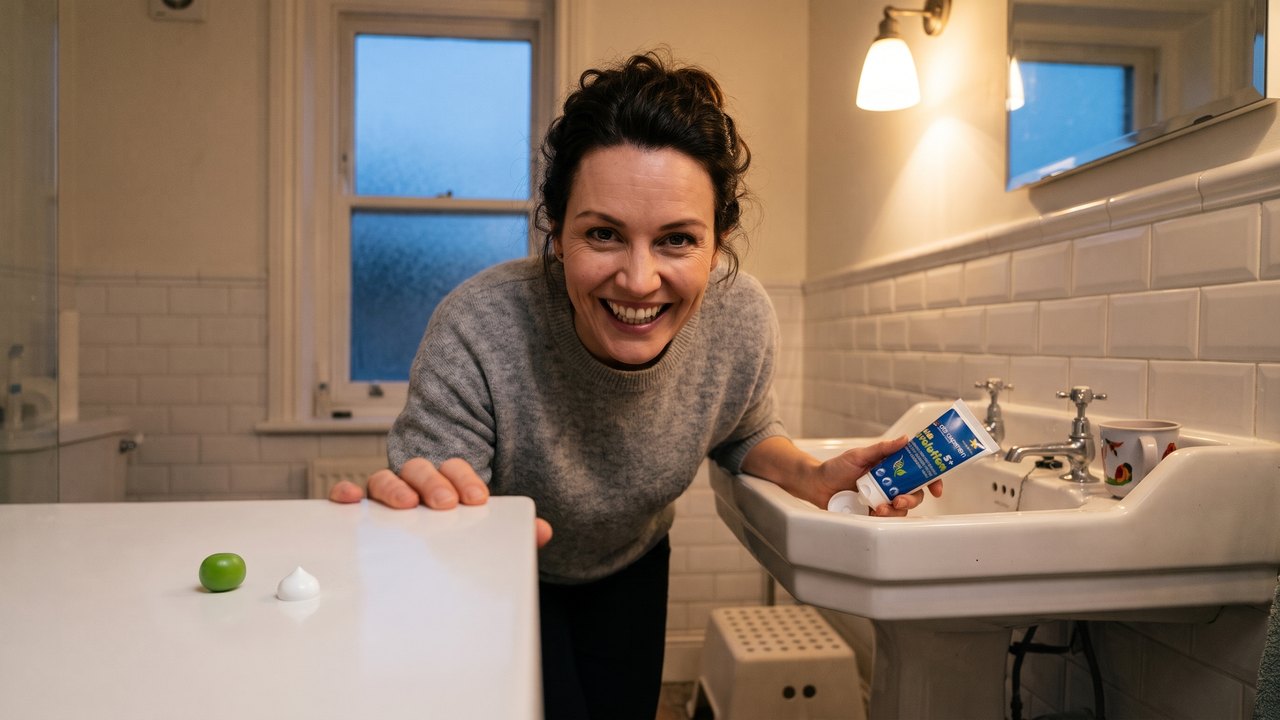
Under 3: a smear the size of a rice grain. From 3 to 6: one pea, 0.25 g, put on the brush by an adult, then spit, not rinse. Adults: a paste of 1 350 to 1 500 ppm, twice a day, then spit, not rinse. If there is a child in your house, try the test from the 2013 study tonight: squeeze what you think is a pea, then put a real pea next to it.
The wave in the advert is for the camera. For a child the right amount is smaller than you think, for you it is larger than a pea, and for both, spitting instead of rinsing keeps the fluoride where it works.