















Clinically Proven Toothpaste: 7 Questions the Box Rarely Answers

Two words on a toothpaste box, clinically proven, cost exactly as much to print as any other two words. Earning them can take years, hundreds of people and a budget most shoppers never imagine. That gap between the price of the claim and the price of the proof is the whole story of this list.
You have probably stood at the shelf with a tube in each hand and picked the one that said it. Most of us have. Nobody at the shelf can read the study, so we read the box. The seven questions below are what a regulator or a systematic review asks before it believes those two words. We name no brands; the questions work on every box, ours included.
1. Proven in people, or in a dish?
In December 2022 the US Federal Trade Commission published its guidance on health claims. Its default is plain: a health benefit claim generally needs randomized, controlled clinical trials in humans. Laboratory and animal studies may give useful background, the guidance says, but without confirmation in people they do not substantiate the claim. So when the small print says laboratory tested, or shows a result on enamel slabs in a beaker, you are reading about a dish, not about a mouth.
2. Proven against what?
A result means nothing without a comparison. The same guidance names the parts of a trial worth trusting: a treatment group and a control group, a placebo where possible, random assignment, and blinding of both the participants and the researchers. A paste that beat no brushing at all has proven that brushing helps. The question is whether it beat an ordinary toothpaste, used the same way, by people who did not know which tube they held.
3. Proven to do what, exactly?
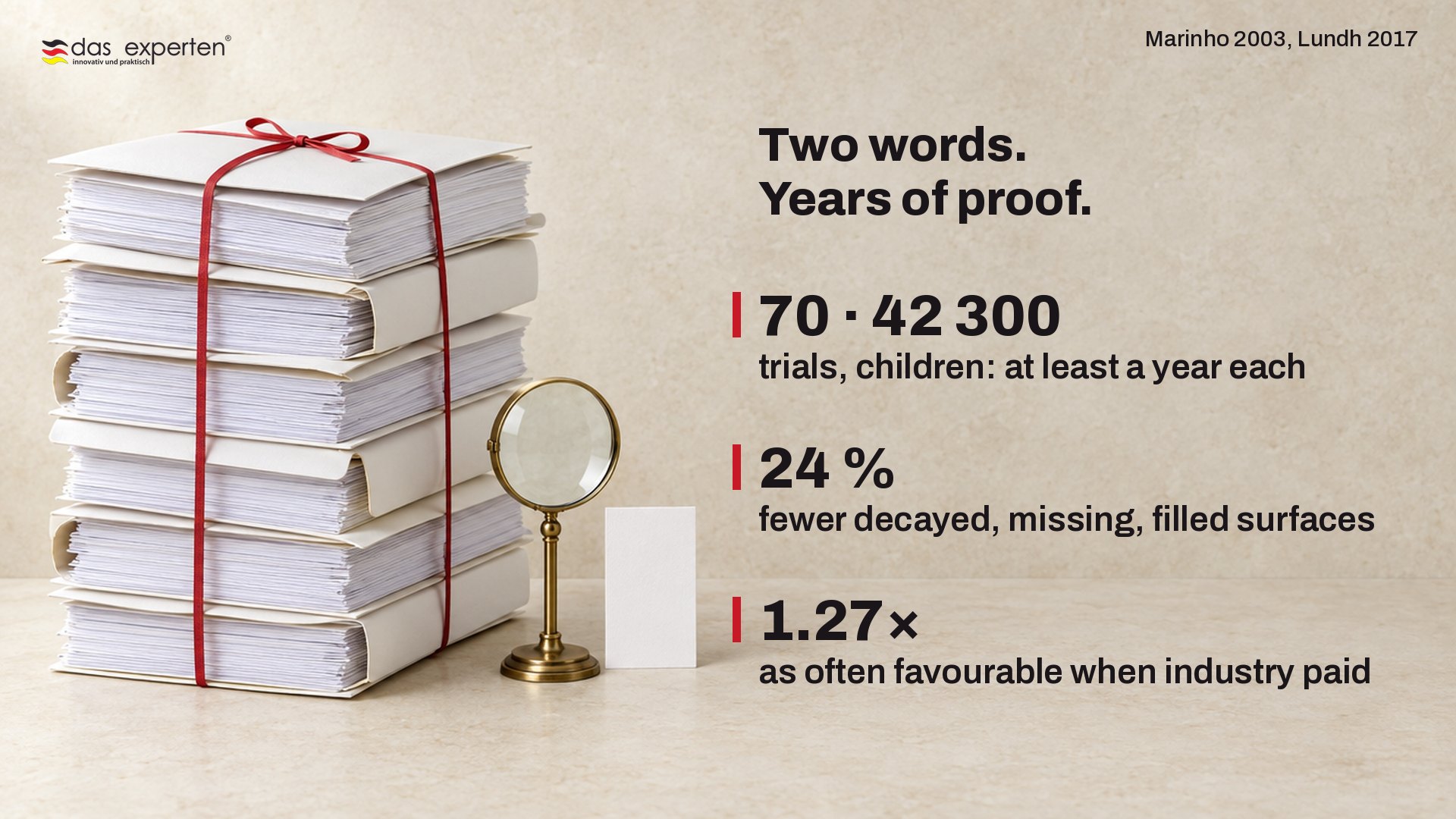
Fewer cavities is a slow outcome, and measuring it is expensive. Look at what the real thing looks like. In 2003 a Cochrane review of fluoride toothpaste gathered 74 studies; 70 of them, with 42 300 children, went into the analysis, and every trial lasted at least a year. The result: 24 % fewer decayed, missing and filled tooth surfaces. That is what proven against cavities means. A study that measured plaque for four weeks has proven something smaller, and an honest box says which.
4. Is the difference big enough to notice?
Statistically significant does not mean large. It means the difference is unlikely to be chance. The FTC guidance draws the line itself: a statistically significant result must translate into a benefit that is clinically meaningful for consumers. It also warns that significance found only by slicing the data after the fact invites suspicion of data mining. Ask how big the effect was, in units you can picture, and whether it was the outcome the study set out to measure.
5. Who paid for the study?
Industry money does not make a study false, and much good dental research is funded by companies. But it is worth knowing. In 2017 a Cochrane methodology review compared 75 papers on sponsorship and research outcomes. Across 25 of them, studies sponsored by industry reported favourable efficacy results 1.27 times as often as studies without that sponsorship. The question is not whether a company paid. It is whether anyone else, with no tube to sell, found the same.
6. What does up to really promise?
Up to is the most generous phrase in advertising. In June 2012 the FTC released a study of advertisements for replacement windows that promised savings of up to 47 %. Its finding: many consumers believe they will get the maximum. The FTC’s position follows from that: an advertiser using up to should be able to show that people are likely to achieve the maximum under normal circumstances. Up to twice as white tells you the best case, not your case.
7. Recommended by whom, and for what?
Dentist recommended sounds like the strongest proof of all. In January 2007 the UK Advertising Standards Authority ruled against a toothpaste poster claiming that more than 80 % of dentists recommended the brand. The survey behind it had let dentists name several toothpastes, and a rival brand was named almost as often. Readers took the figure as a preference over all others; the survey had not measured one. A recommendation tells you about a survey question. Ask what the question was.
What the regulators do and do not check
Some checks exist. The American Dental Association grants its Seal only after its scientific council evaluates the maker’s data; a sealed toothpaste that claims cavity protection must contain fluoride, and its abrasivity must not exceed RDA 250. The same ADA page notes that the US Food and Drug Administration does not test toothpastes to verify compliance. In the European Union, Regulation 655/2013 sets six common criteria for every cosmetic claim, and the Irish regulator sums up two of them: every claim, stated or implied, must be supported by evidence, and must not go beyond it. Neither system reads the box for you at the shelf.
Das Experten makes toothpaste too, so the seven questions apply to our boxes as well. On this page you will find no efficacy figure for our own products, and that is deliberate: a figure goes into our copy only with a study of the finished product behind it, one that names the comparison, the outcome, the people and the duration. Our toothpastes carry their full ingredient lists, and if you want to know what a formula is built on, our list of six formula patterns worth a second look is the place to start.
Next time two words stop your hand at the shelf, ask the box the seven questions. If it cannot answer them, the words were decoration.