















Toothpaste for Dental Implants: Titanium Cannot Decay. The Gum Around It Can.

On 20 October a customer who had just bought our whitening paste sent a question: can I use it if I have implants, and how? It is a good question about the wrong object. You paid for the titanium, the crown and the months of healing, so the instinct is to protect the expensive part. The expensive part is the one thing in your mouth that can never get a cavity.
Which toothpaste for dental implants, then? Almost any gentle one. The real answer sits a few millimetres lower, in the collar of gum that holds the implant, and that collar is where implants are actually lost.
The titanium was never the weak point
In the early 1950s a young Swedish researcher, Per Ingvar Brånemark, screwed small titanium chambers into the leg bones of rabbits to watch blood flow through living bone. When the experiment ended he could not get them out. The bone had grown onto the metal. In 1965 in Gothenburg he put four titanium implants into the lower jaw of Gösta Larsson, a man in his thirties who had been born with deformed jaws. When Larsson died in 2006, the implants were still in place and still working, about forty years later.
Titanium does not decay. There is no enamel to dissolve and no nerve to ache. Which is exactly why the question about the paste feels urgent and is not: the metal is the part of the arrangement that needs the least protection from you.
The weak point is a collar of gum
Bacteria do not need anything to eat into. They need a surface to live on, and the line where an implant crown meets the gum is a very good one. In a Swiss study, 15 people with implants agreed to stop cleaning one side of the lower jaw for 3 weeks. Plaque built up on teeth and implants alike, but the gum around the implants reacted more strongly than the gum around their own teeth. When cleaning resumed, three weeks were not enough for either to return fully to where it started (Salvi et al. 2012).
Dentists call the early, reversible stage peri implant mucositis: red, swollen gum that bleeds when touched, with the bone still intact. The later stage is peri implantitis: the same inflammation, now eating the bone that holds the implant. Pooling 11 studies, a Gothenburg review found mucositis in 43 % of people with implants and peri implantitis in 22 % (Derks and Tomasi 2015).
Nine years later, in the city where it began
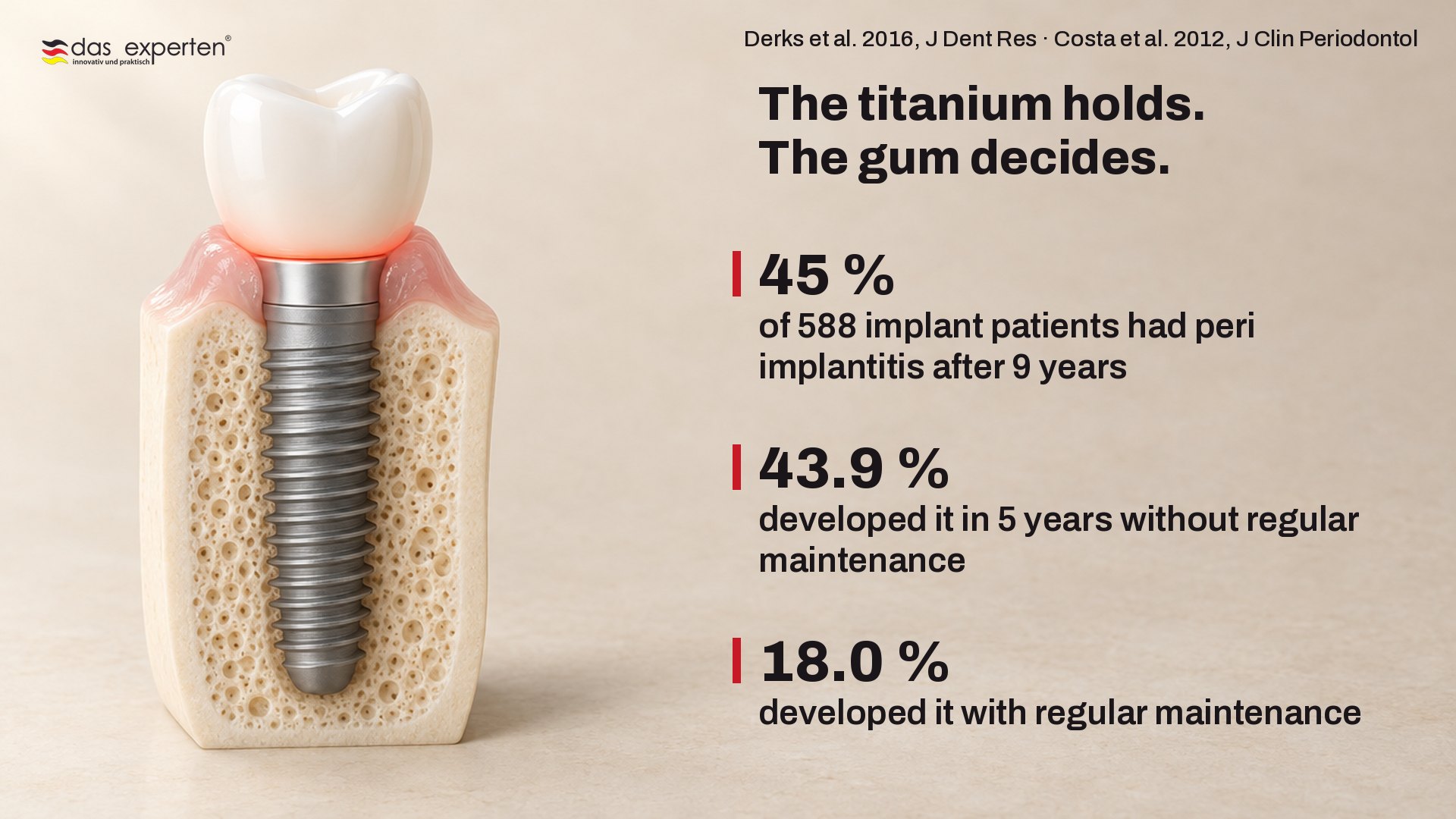
The number that should stop you comes from the same city as Larsson's operation. Researchers in Gothenburg drew 588 people at random from patients who had received implants nine years earlier and examined every one of them. 45 % had peri implantitis by the study's definition, which counts bleeding plus more than half a millimetre of lost bone. Moderate or severe disease, with more than 2 mm of bone gone, was found in 14.5 % (Derks et al. 2016). Brånemark proved that titanium can stay in bone for a lifetime. Half a century later his own city showed what usually decides whether it does.
So which toothpaste for dental implants?
In 2015 seventeen specialists of the European periodontal workshop weighed the evidence on preventing this disease. Plaque, they wrote, is the established cause. Brushing by the patient, with a manual or a powered brush, is an effective preventive measure. And adding antiseptics did not make professional cleaning work any better (Jepsen et al. 2015). Nowhere in that list is a special paste.
What a paste can do is not harm. A crown is glazed, and the polished collar of an implant is smooth for a reason: scratches give plaque somewhere to hold on. So choose a paste of low abrasion and do not scrub with it. Do not expect it to whiten the crown either: the colour of a ceramic crown is fired in when it is made, and no toothpaste changes it. The effort goes elsewhere: a soft brush angled at the line where crown meets gum, and something that reaches between the implants, because that is where a brush stops.
The appointment you are tempted to skip
Here the risk turns lopsided. Mucositis can be reversed. Lost bone around an implant is much harder to win back. In Brazil, 80 people who already had mucositis were followed for five years. Among those who skipped regular maintenance visits, 43.9 % developed peri implantitis. Among those who kept them, 18.0 % (Costa et al. 2012). The same gum, the same metal, more than twice the risk, and the only difference was a professional cleaning on the calendar.
You may brush more carefully around your implant than anywhere else in your mouth and still never see the place where trouble starts. The signal is small: a little blood on the brush at the implant, or gum there that looks redder than its neighbours. That is the sign specialists treat as the line between health and disease, and it is a reason to call your dentist, not to change your paste.
To the customer who asked: INNOWEISS has a silica base that its product record places below RDA 30, a low figure that is still not zero. No study above tested it on implants, and we do not promise what one has not shown. Use it gently, like any low abrasion paste, and give the attention to the gum line, the gaps between implants and the hygiene visit.
The titanium will stay as long as the gum lets it. Your paste was never the question. Your next two minutes at the gum line are.